 Not One More
You don't have to quit forever. You have to get through the next two minutes.
Not One More is a friction gate for nicotine. When you want a cigarette, a vape or a pouch, you open the app and do a two minute Hit instead. The craving peaks and passes while you are busy.
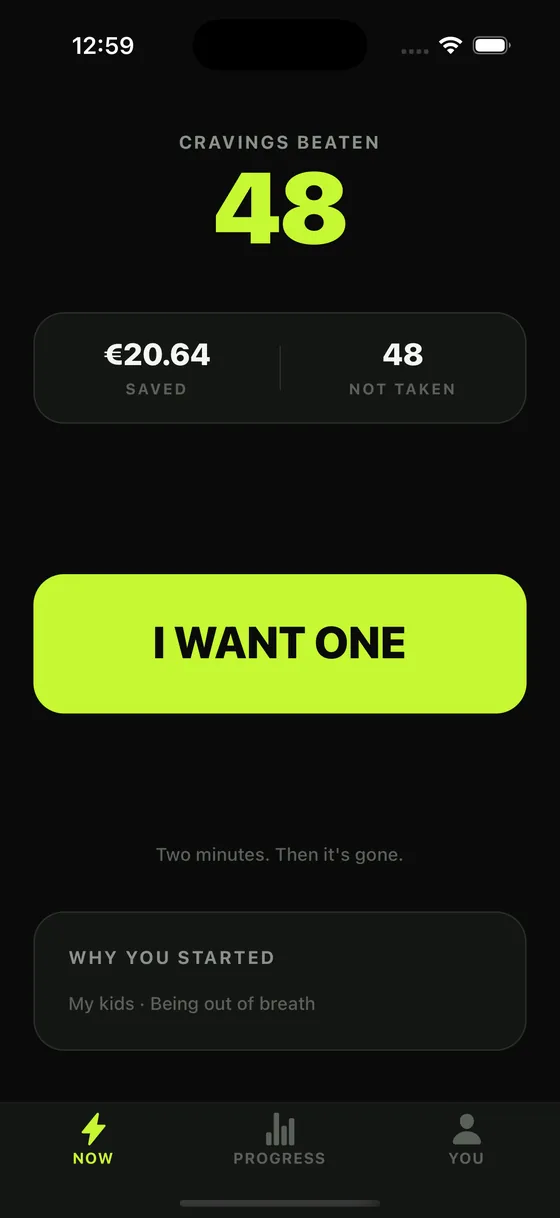
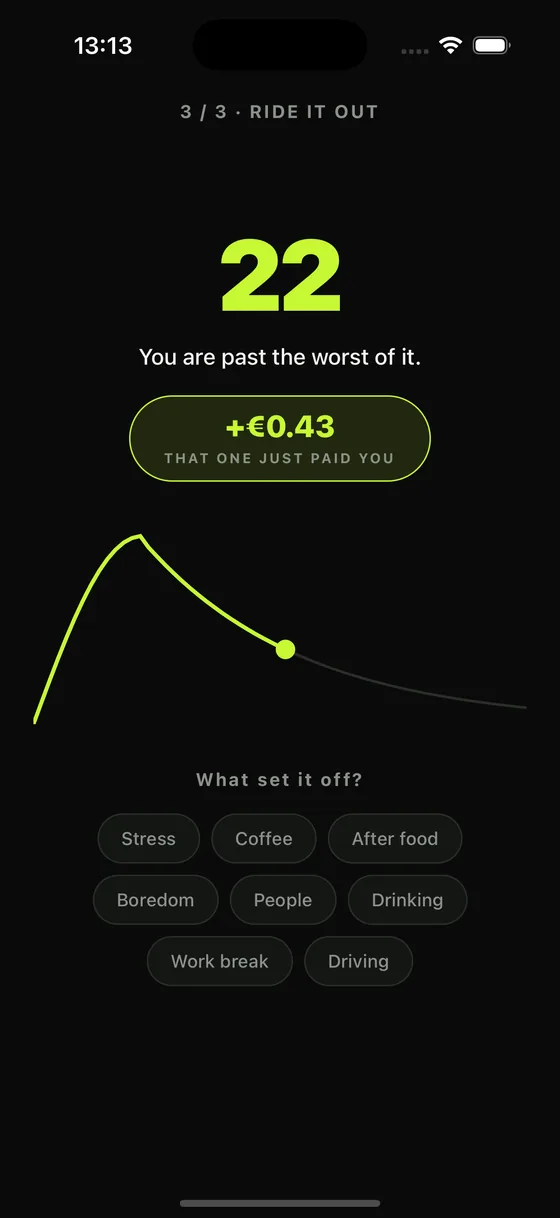
Nicotine reaches your brain in ten seconds. No app beats that. So we do not try. We make the craving wait, and we make waiting survivable.
These are numbers about how cravings behave, not about our users. Sources are in the evidence section.
The Hit
Three beats, about two minutes
Matched to the shape of a craving. One tap starts it, and the screen stays awake until it is done.
Breathe
About 30 seconds
Three physiological sighs. It mimics the ritual of a cigarette on purpose, because much of what a cigarette calms is the breathing pattern, not the drug.
Burn
About 30 seconds
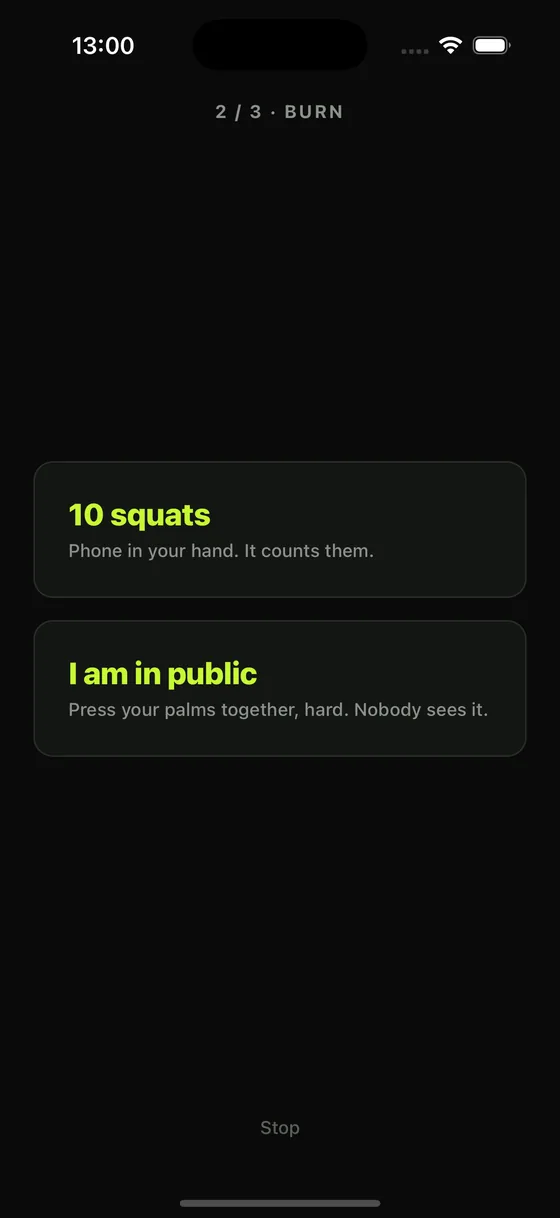
Ten squats, or a thirty second isometric hold when squats are impossible. The phone's motion sensor counts them, so a Hit is verified rather than self-reported. Two options and not six, because choosing is itself a delay at the moment speed matters.
Ride
45 seconds
The craving curve animates while it passes. You tag what set it off. Then one question, answered honestly: still want it.
Reps you did not have to be trusted on
The Burn beat counts with the accelerometer, so a completed Hit means a completed Hit. You can skip verification and the Hit still counts. It is simply left out of the statistics comparing which action works for you, so that comparison stays worth reading.
Motion, not camera. It works in a dark stairwell, in a coat pocket, with no permission dialog appearing in the middle of a craving.
The number that survives a bad day
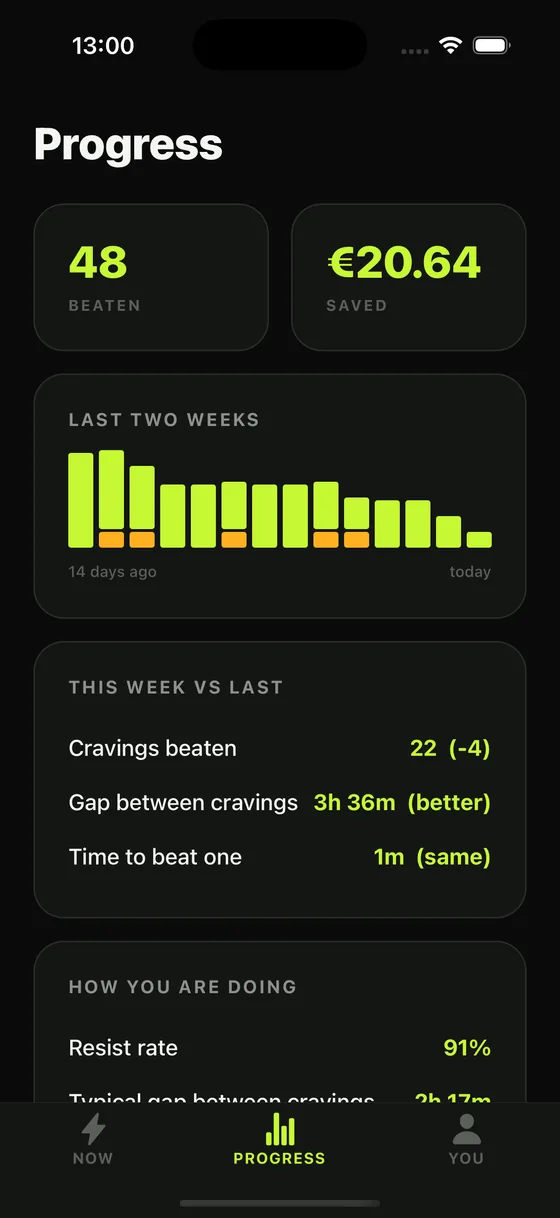
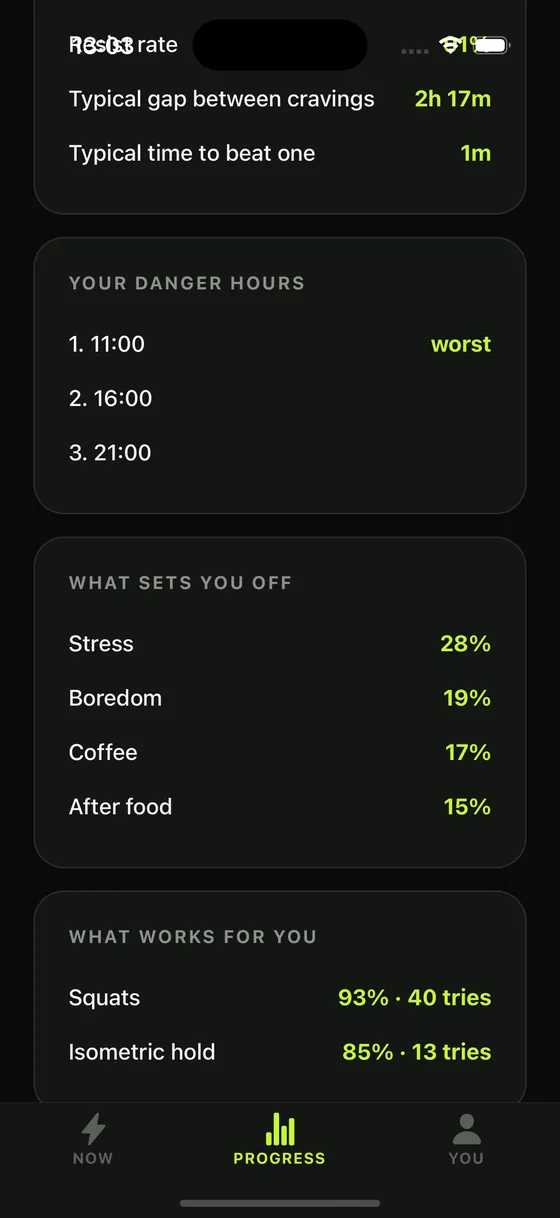
The headline figure is cravings beaten, and it only goes up. Days smoke-free is the number every other app leads with, and one cigarette sets it to zero. That is the moment people delete the app.
Underneath it: how often cravings arrive, how long they take to pass, what set them off, and which action works best for you specifically rather than for people in general.
The hold exists because people crave outside the office, in the cold, with colleagues watching. An app whose only answer is twenty squats is an app that gets closed.
You choose it on the Burn screen, in the moment, not in a settings tab. Whether squats are possible depends on where you happen to be standing, which a preference set weeks ago cannot know, and nobody opens settings mid-craving.
- Coffee
- Stress
- After a meal
- Alcohol
- Social
- Boredom
- Driving
- Work break
- Waking up
The honest mechanism
The delay is the intervention
Nicotine reaches receptors in about ten seconds. No squat does that, and we will never claim otherwise. What is true is narrower, and it is enough.
A craving peaks and passes in roughly three to five minutes. This is the convention taught in stop-smoking counselling by services including the NHS and the American Cancer Society. It is clinical practice rather than hard laboratory data, and we would rather say so than dress it up.
Short bouts of exercise reduce cravings and lengthen the time to the next one. This is the best-evidenced lever available without medication (Ussher and Taylor).
Extended-exhale breathing lowers arousal in real time (Balban et al., 2023). Much of what makes a cigarette feel calming is this breathing pattern rather than the drug.
Not One More does not replace nicotine chemically and is not a medical treatment. It is not a substitute for nicotine replacement therapy. If you use patches, gum or lozenges to help you quit, keep using them. Combining behavioural support with NRT is the best-evidenced route, and the app is built to sit alongside it.
What it will never do
Four promises
These are constraints on the product, not marketing. They are written into the codebase as rules.
- Never a locked door mid-craving If your trial has ended and you have not subscribed, the app still opens straight into 30 seconds of guided breathing, before it mentions money. That is not a free tier: nothing is logged, verified or measured. It is there so that opening the app is never worse than useless to someone about to cave.
- Never lead with days smoke-free One cigarette zeroes that number and people delete the app in shame. The headline here is cravings beaten, which only goes up.
- Never shame you for a slip Logging that you used anyway takes one tap, in amber, with no lecture and nothing sent afterwards. Your headline number is cravings beaten, which never resets, so one bad night does not erase the work behind it.
- Never tell you a craving is coming Exactly one notification exists, and it is about money: a reminder the day before a free trial ends. Nudges before your usual danger hours were built and then deleted, because "this is usually about now" announces nicotine to someone who was not thinking about it. An app for not smoking should not say smoking to you unprompted.
Price
Three days free, then it is paid
The trial covers everything: unlimited Hits, verified reps, your trigger map, your danger hours, what you have saved, and which action works best for you specifically. No card is charged until it ends.
Three days is not an arbitrary number. Nicotine is largely cleared and withdrawal peaks around day two to three, so the trial spans the hardest stretch, which is exactly when the app should have to prove it is worth paying for.
After that it is a subscription. The price and billing period are shown in the app before you confirm, and you can cancel any time from your Apple ID settings.
Subscriptions renew automatically until cancelled. See the terms for the full detail.
Questions
Frequently asked
How long does a nicotine craving actually last?
Usually three to five minutes, whether or not you smoke. A craving is a wave: it rises, peaks and falls. Smoking ends it early, which teaches you that smoking is what ends it. Waiting it out teaches you the opposite, and the waves get smaller each time you do.
Cravings get less frequent over weeks rather than disappearing on a fixed date. The app tracks the frequency and how long yours take to pass, because a shrinking time-to-resolution is the cleanest evidence the response is weakening.
Does exercise really reduce cravings?
Yes, and it is the best-evidenced thing you can do without medication. Short bouts of moderate exercise reduce cigarette cravings and lengthen the time until the next one (Ussher and Taylor). You do not need a gym or a workout. The effect shows up with well under a minute of effort, which is why the Burn beat is about 30 seconds.
Does this work for vaping and pouches, or only cigarettes?
All three, and it was built that way from the start rather than retrofitted. You pick your substance during setup and the app does the money and unit maths in your terms: puffs, pouches or cigarettes.
Heavy vaping in particular generates more craving events than a pack a day, because a vape is available in more moments. More events means the trigger map and the personalisation get useful faster.
Is this a replacement for patches, gum or lozenges?
No, and we will not position it that way. Nicotine replacement therapy addresses the chemistry; this addresses the moment. Combining behavioural support with NRT is the best-evidenced route to quitting, so if you are using NRT, keep using it. The app asks whether you are, specifically so it never suggests otherwise.
What happens if I slip and smoke?
You log it in one tap and nothing bad happens. No lecture, no reset to zero, no notification afterwards. Logging a slip actively silences the app for a while, because a nudge arriving an hour after you caved reads as rubbing it in.
This is deliberate. If logging a slip feels like a confession, people stop logging, and then every number in the app quietly drifts toward looking better than things really are.
What if I am somewhere I cannot exercise?
Take the hold instead: an isometric squeeze nobody around you will notice. You choose it on the Burn screen itself, in the moment, because whether squats are possible depends on where you are standing right then.
It is deliberately still effort. An escape hatch that removed the work would stop being a choice about your surroundings and become the button everyone presses on a bad day.
How many notifications will I get?
One, ever: a reminder the day before a free trial ends, so a charge is never a surprise. There are no streak reminders, no daily check-ins, and nothing at all after a slip.
There is deliberately no nudge before the hours you usually struggle in. That feature was built and then deleted, because telling someone "this is usually about now" puts nicotine in the head of a person who was not thinking about it.
Does it work without a signal?
Completely. Your phone holds the real copy of everything and nothing on the craving path waits for the network. A backup syncs when you happen to be online, so a new phone can restore your history, but it is never something the app waits on. Someone standing outside waiting for a server has already lit it.
Do I need an account?
No. The app works with no name, no email and no sign-up. Sign in with Apple is optional and exists for one reason: without it, your history cannot move to a new phone.
What does it cost?
Three days free, covering the whole app, then a subscription. The price is shown in the app before you confirm anything and you can cancel from your Apple ID settings. Once a trial has ended, an unsubscribed app still opens into 30 seconds of guided breathing before it shows you a price. Not a free tier, but not a locked door either.
What data do you collect?
Your craving history and your setup answers, backed up so you can restore them. No advertising identifiers, no third-party analytics, no ad networks, nothing sold. The voice note you record during setup never leaves your device. We cannot listen to it, and there is no copy on our side. You can delete everything from inside the app, without emailing anyone. The full detail is in the privacy policy.
Is there an Android version?
Not yet. iPhone first.
Will this cure my addiction?
No, and anything claiming otherwise is selling you something. Not One More is a behavioural tool for one specific moment: the two minutes in which you decide. It is not a medical device and does not provide medical advice. Free stop-smoking services in most countries are genuinely good and worth using alongside it.
Get through the next two minutes
Then do it again the next time. That is the whole method.